
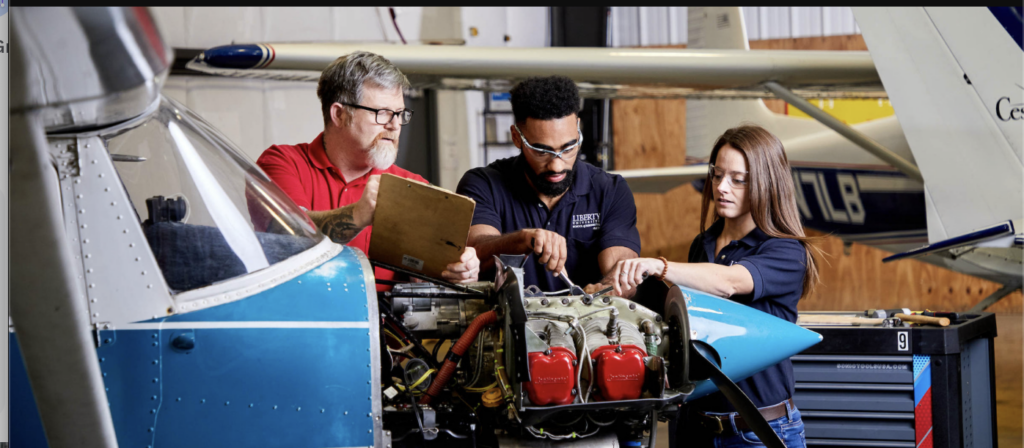
Before you learn how to maintain an aircraft, there’s something even more important you need to understand.
Why do highly trained, fully qualified aircraft engineers still make mistakes?
Not because they don’t know the manual. Not because they lack skill. The answer has almost nothing to do with technical ability and everything to do with a module most students can’t wait to get through.
More than just Module 9
Ask most Part-66 students which module they’re least excited about, and Human Factors (Module 9) comes up often. It has no engines, no circuits, no aerodynamics.
Compared to Propulsion or Aircraft Structures, it can feel like the «soft» module standing between you and your license, a box to tick before the real training begins. That reputation is a mistake, and once you see why, it’s hard to unsee.
The uncomfortable truth behind most maintenance errors
Here’s the part that surprises most students: when investigators dig into serious maintenance-related incidents, the cause is almost never «the technician didn’t know what to do.» It’s something far more ordinary: a rushed shift handover, a distraction at the wrong moment, a shortcut that had quietly become normal, or simply not feeling able to say «wait, I think we need to double-check this.»
That’s what Human Factors actually studies: how human capabilities and limitations physical, mental, emotional shape performance, and how they quietly set the stage for errors long before anyone notices something is wrong. It’s not about what you know. It’s about the very human conditions that cause qualified, knowledgeable people to still get it wrong.
This is exactly why EASA made it mandatory within the Part-66 syllabus. Across aviation history, the pattern kept repeating: skilled people, ordinary human conditions, serious consequences. A well-trained technician can learn to recognize those conditions in real time which is the entire point of Module 9.
The «Dirty Dozen»: twelve ways a good technician can still get it wrong
Picture a technician nearing the end of a night shift, three hours past when they meant to finish, waiting on a colleague who was supposed to double-check a torque setting. Nobody involved is careless. Nobody is unqualified. And yet this is precisely the kind of moment where things go wrong not from a skills gap, but from a handful of very human conditions stacking up at once.
Transport Canada was the first to formalize this pattern into a list, now taught industry-wide as the **»**Dirty Dozen» = twelve conditions most commonly linked to maintenance errors:
- Lack of communication = a critical detail not passed on at shift handover, leaving the next technician to unknowingly continue under the wrong assumptions.
- Complacency =assuming a routine check is fine because it always has been, and quietly relaxing the scrutiny it actually needs.
- Lack of knowledge = attempting an unfamiliar task without the training or reference material to do it correctly.
- Distraction = a phone call, a conversation, or an interruption mid-task that causes a step to be skipped or repeated.
- Lack of teamwork = two technicians each assuming the other has completed a shared task, when neither has.
- Fatigue= reduced attention and judgment after a long shift, night rotation, or insufficient rest.
- Lack of resources = not enough time, staff, or the right tools to complete a task to standard, creating pressure to cut corners.
- Pressure = schedule or commercial pressure to return an aircraft to service faster than the task safely allows.
- Lack of assertiveness = noticing something questionable but not feeling able to raise it with a supervisor or a more senior colleague.
- Stress = personal or workplace stress reducing focus and increasing the likelihood of oversight.
- Lack of awareness = losing sight of how one individual task affects the aircraft as a whole.
- Norms = «we’ve always done it this way,» even when the official procedure says otherwise, and the informal shortcut has quietly become the accepted standard.
- Look at that list again. Not one item requires a lapse in technical skill. All twelve can happen to the most experienced engineer on the team which is exactly why Human Factors isn’t a box to tick once and forget. It’s a discipline you carry for your entire career.
A case that changed the industry
One of the clearest illustrations of why this matters comes from Aloha Airlines Flight 243, a Boeing 737 that suffered explosive decompression in April 1988 when an 18-foot section of its upper fuselage tore away mid-flight. The US National Transportation Safety Board (NTSB) determined the probable cause was Aloha Airlines’ maintenance program failing to detect known fatigue and disbonding damage in the fuselage skin despite the aircraft’s age and known industry concerns about metal fatigue in high-cycle airframes.
The NTSB’s investigation didn’t stop at the metal itself. It also pointed to inadequate inspection training, an over-reliance on visual checks despite their known limitations, and a maintenance culture that had come to treat visible deterioration as normal a textbook case of complacency and normalized norms, two items directly on the Dirty Dozen list, decades before that framework became standard industry training. In the aftermath, the US Congress passed the Aviation Safety Research Act of 1988, and the FAA launched its National Aging Aircraft Program regulatory changes that reshaped how the entire industry inspects older aircraft.
The lesson wasn’t about any single missed bolt or crack. It was about a system where complacency and the normalization of known issues, not a lack of technical ability, allowed a serious risk to go unaddressed for years.
Why it belongs in your license, not just your exam
Module 9 is part of our own EASA Part-66 B1/B2 curriculum, covering exactly this: human performance, limitations, and how to build the habits clear shift handovers, double-checking critical tasks, and speaking up when something feels off that catch small problems before they become serious ones.
A technician can be technically excellent and still make a safety-relevant mistake if they’re exhausted, rushed, or don’t feel able to flag a concern. Human Factors training exists to close that gap. It’s not a formality standing between you and your license it may be one of the most practically useful things you study on the way to it.
Sources: US National Transportation Safety Board (NTSB) accident report AAR-89/03; US Federal Aviation Administration accident lessons-learned archive; Transport Canada «Dirty Dozen» human factors framework.
Explore our EASA Part-66 B1/B2 Aircraft Maintenance License training